Frequently Asked Questions
Standards for Official Statistics on Climate-Health Interactions (SOSCHI) is a 4-year project funded by Wellcome (2022-2026) to develop a well-defined set of indicators to measure climate-related health impacts. The aim is to support regular reporting and monitoring at global, national and potentially sub-national levels. For more information see the About us page.
An "indicator" is a single numeric measurement which describes a clearly defined health outcome in a specific population at a given time. The definition of the indicator includes the measurement units, the numerator and denominator (if relevant), etc. e.g. Rate per 100,000 population of deaths from all causes, attributable to excess heat (ambient mean outdoor temperature).
This website is a methods, tools and knowledge-sharing platform. It cannot currently be used to report or store any data.
The primary purpose is to support the dissemination of the SOSCHI statistical framework, and support users to produce indicator metrics using their own underlying climate and health input data. Guidance for users includes topic documents , statistical code and tools and other resources .
The SOSCHI project has engaged with a range of global stakeholders to avoid duplication of effort and support global implementation of the SOSCHI framework. The main benefit of the SOSCHI framework, and its contribution to this field, is providing National Statistics Organisations (NSOs) and other government institutions with harmonised indicators, validated methods and practical tools, to improve the monitoring of climate change impacts on health.
Six headline indicators from the SOSCHI framework were endorsed by the 57th session of the United Nations Statistical Commission (3-6 March 2026) as part of the authoritative UN Global Set of Climate Change Statistics and Indicators . This was progressed through the UN Expert Group on Environment and Climate Change Statistics (EG-ECCS) and its Sub-Group on Climate and Health.
For more information see the SOSCHI framework report (section 2.3: Relationship to other frameworks).
The following stages in the project were used to define the project scope:
- The Discovery Phase (2022-23) involved defining the scope and approach of the statistical framework.
- The Alpha Phase (2023-24) involved outlining the scope of each topic, identifying potential indicators and developing methods.
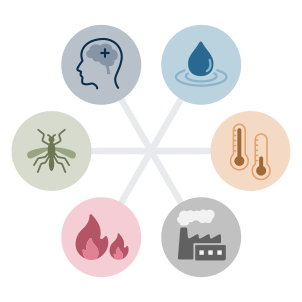
- The Beta Phase (2025-25) focussed on six priority topics - selected for further methods development and production of indicator tools on the platform.
For more information on the framework development process see section 1.3 of the SOSCHI framework report
Users need to produce climate-health indicators using their own underlying input data sources.
Use the search function in the header to navigate to specific topics or indicators you are interested in. If you want to produce indicator metrics, you will first need to identify and prepare the input data sources. Once the input data is in the required structure, you can use the R package to produce selected climate-health indicator metrics for your country or area. Additional guidance is available on topic documents, guidance videos and the Additional resources page.
All indicators in the SOSCHI framework can be used to provide estimates at both a national and sub-national level. The specific geographic granularity will vary by country, depending on the statistical power. Furthermore, some methods are only recommended for regional level analysis. For further guidance, see the Framework topic pages for links to the methods documents, Section 2: Data and variables.
The climate-health indicators are not based on direct counts. For all indicators these are estimated based on statistical models. For further guidance see the Framework topic pages for links to the methods documents, Section 2: Data and variables.
All the proposed indicators include guidance on potential disaggregations to identify vulnerable groups and inform policy interventions. Because of data limitations in some countries, and potentially differing policy needs, the feasibility of this will depend on data availability and quality. Furthermore, if an outcome is relatively uncommon, the number of cases and the statistical model techniques used may be insufficient to provide reliable results. For further guidance see the Framework topic pages for links to the methods documents, Section 2.4: Disaggregations of data.
The reliability of indicator metrics produced by the SOSCHI framework is crucial, given that the main purpose is to be suitable for official statistics production.
Official statistics are the format in which a National Statistical Office, or other analytical teams in government, communicates statistical outputs to the public and other government bodies (including policy makers) to inform and make decisions.
Key characteristics of an official statistic include its relevance, accessibility, and statistical quality to accurately and timely inform users. Please see the SOSCHI Framework Report, section 5.2: Statistical quality for more information on the quality assurance processes used in the development of the framework and R package .
The following sections of the indicator methods documents will also provide users with guidance to support their interpretation of results, and explain any potential limitations:
- Section 2.5: Data limitations
- Section 4: Communication and interpretation
- Section 5: Methods limitations
An understanding of descriptive statistics is advised. Each indicator's methodology document provides guidance for running the analysis, interpreting the results, and communicating uncertainty.
Required R coding ability depends on which analysis option a user chooses. The project provides three options as described on the R package page. The "low code" option is recommended for the most comprehensive analysis and requires users to be able to read and edit R code.
The published climatehealth
R package
is
available from the
Climate-Health R Package Github page
and on
CRAN
.
The source code is also available in the
onssoschi/climatehealth GitHub repository
.
To install and use the package, an R environment is required. The package requires
R 4.4.0 or later, and R 4.4.1 is recommended where possible. Users will also need software
for data preparation, following the guidance provided in sections 2.3 and 3.2 of the
respective indicator methodology documents.
The end-to-end process for producing the SOSCHI climate-health indicators is complex. So, it is likely that there may be some errors in the data production process. The various resources provided, aim to provide users with sufficient guidance. However, if users are unable to resolve these, please contact our [email protected] inbox for further support and feedback.